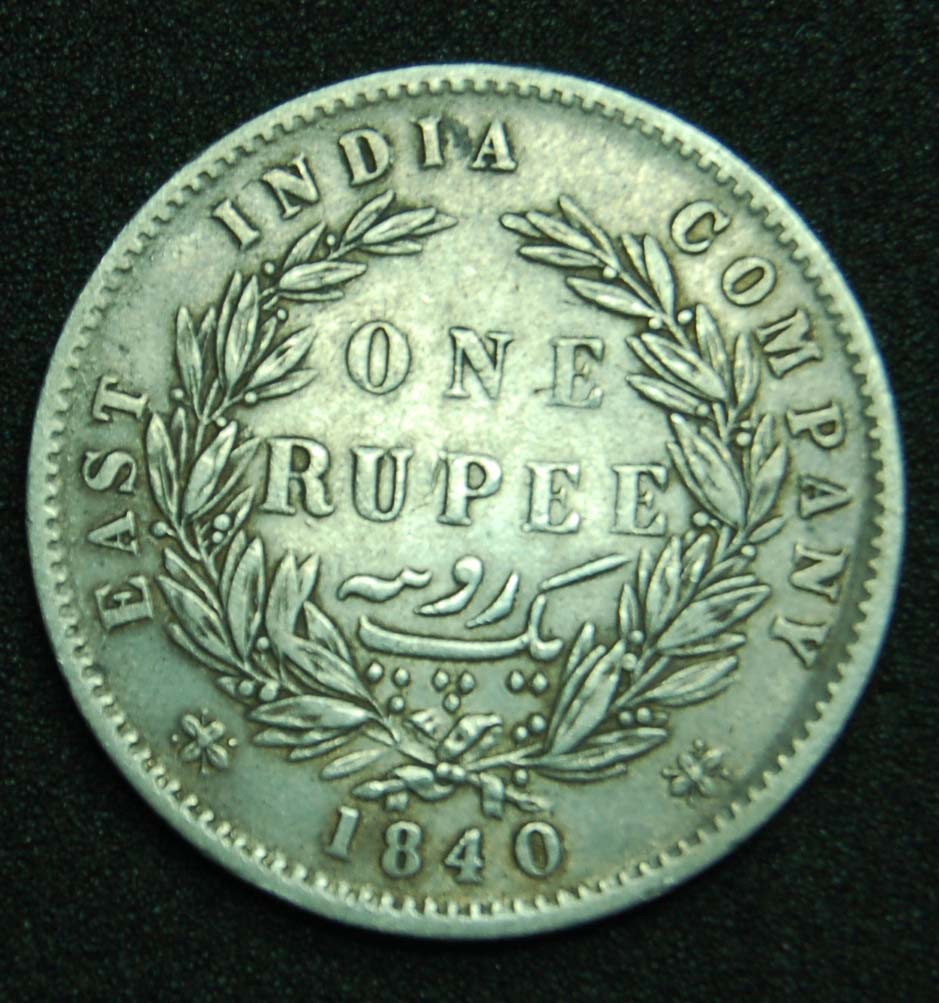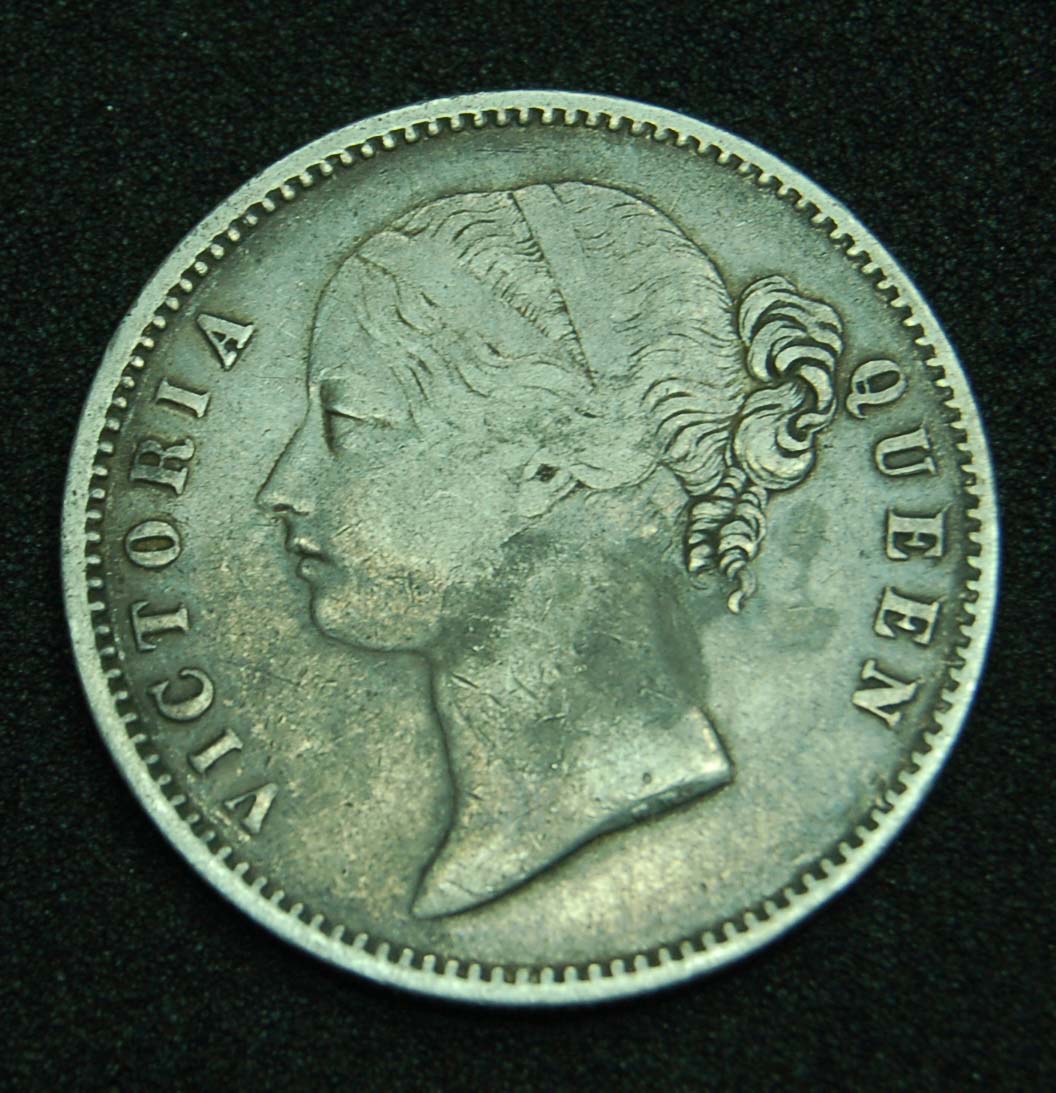


Type :- One Rupee
Year :- 1840
Weight :- 11.52g [11.66g]
Metal :- 91.7% Silver.
Diameter :- 30.50 mm
Edge :- Reeded Alignment :- Medal
Mint :- Calcutta
Mintage :- 398,553,660 (including small diamond varirty). Mintage Years :- One year type with various varieties including Bombay mint. 1849 date also exits as
Obverse :- The value within a wreath of laurel: ONE RUPEE Around this is the legend and date: EAST INDIA COMPANY 1840 All within a raised, toothed rim. 28 berries with large diamonds in Persian One Rupee. 28 berries (13 on left and 15 on right).
Reverse :- "Victoria Queen" divided by bust facing left.
When Wyon's new matrices for the silver coinage reached India in December 1849, work began immediately on preparing the dies. However, problems were encountered with the convexity of the reverse and this prevented the obverse being fully raised. New reverse dies were therefore prepared, copied from Wyon's originals, and were completed in May 1850. The coins continued to show the fixed date of 1840. Dies were sent to Bombay on 11th February 1851 and to Madras on 17th June 1851. Madras coins are most easily distinguished by the presence of extra initials added after W.W. on the truncation of the neck (W.W.S for J. T. Smith, W.W.B for J.H. Bell? and W.W.BO for T. Boycott?). It is interesting to note that the diameter of coins with the extra initial, and therefore from Madras, is 30.7-30.8mm, as opposed to 30.5-30.6mm for most coins with the simple W.W. initials. However, there are a small number of coins with the W.W. initials that have a diameter of 30.7mm. This would suggest that an extra initial was not added to all Madras coins, and that diameter should be used to distinguish the Madras coins from those struck at Bombay and Calcutta, and that mint attribution should not rely solely on the presence or absence of the extra initial. Therefore, an extra coin has been added to the catalogue. NB Total Mintage = 767m. Calcutta = 399m [398,553,660] (52%), Bombay = 313m [312,598,076] (41%), Madras = 55m [55,049,201] (7%).
Of the coins examined, those with diameter 30.5-30.6 = 54 coins (90%), diameter 30.7-30.8 = 6 coins (10%). These figures support the assertion that the coins with diameter 30.5-30.6 are those from Calcutta plus Bombay and the larger coins are from Madras.
No marks have been identified to conclusively distinguish Calcutta minted coins from those struck at Bombay, although some possible features have been suggested such as the presence or absence of a raised mid-vein on the leaf to the left of the ribbon on the reverse. The mints usually made their privy marks clearer than this and the argument for this as the distinguishing mark seems unconvincing. The shading on the ribbon on the reverse recorded by Pridmore is very difficult to see. This feature has therefore been excluded the catalogue. Many other minute differences can be identified such as differences in the leaf veins. Again these have not been included in the main part of the catalogue since they are too difficult to identify.
Note :- This Coin is also add in The Collection.of RBI (Reserve Bank Of India)